
Giacomo da Lentini’s Sonnets Retranslated
review by Primo Magazine (fall 2026)
Long before Dante, Petrarch, and Boccaccio established their places among the giants of Italian literature, a remarkable experiment in poetry occurred in Sicily. At the court of Emperor Frederick II, a group of educated courtiers began composing sophisticated verse in Sicilian rather than Latin. Foremost among them was Giacomo da Lentini, the poet generally credited with one of literature’s most consequential inventions: the sonnet.
In Giacomo da Lentini’s Sonnets Retranslated into Sicilian, scholar Gaetano Cipolla undertakes something more ambitious than translating a medieval poet. He attempts to give da Lentini his Sicilian voice back.
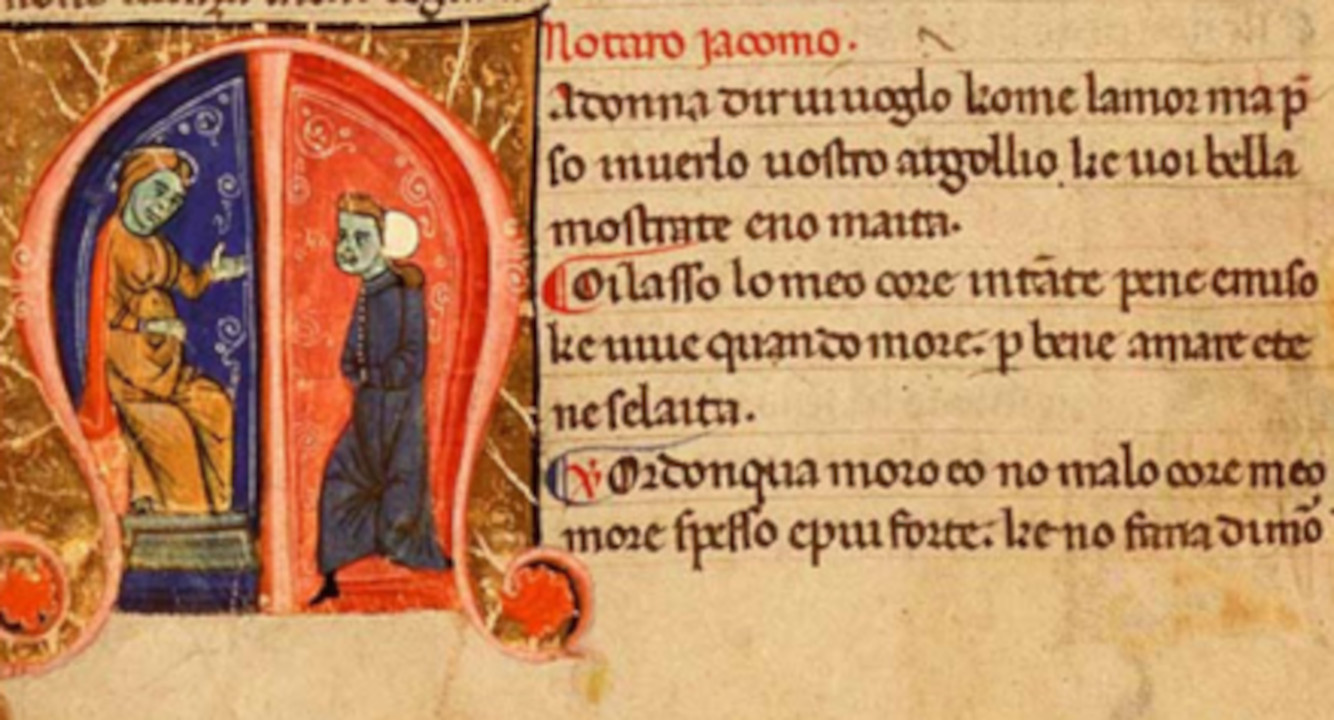
Born in Lentini, Sicily, da Lentini served Frederick II as a notary. His name appears in surviving documents as Notaro Jacomo. Cipolla places him at the center of the Scuola Siciliana, the Sicilian School of poets that flourished around Frederick’s imperial court during the first half of the 13th century.
Influenced by the troubadour tradition of Provence, the poets of Sicily eliminated any musical or performative character while refining the treatment of romantic love. Their Sicilian became an important literary language. Cipolla cites Dante’s recognition of the School’s significance. He argues that its influence extended forward to the Dolce Stil Novo and ultimately to Petrarch, Boccaccio, and the Renaissance.
After Frederick II died in 1250 and his political order declined, original manuscripts of the Sicilian School largely disappeared. The poems survived through copies made by scribes, or amanuensi, in Florence, Pisa, and Venice. Cipolla argues that these scribes did not merely copy the Sicilian. They adapted the poems to their own languages, most consequentially Tuscan.
Thus, later generations were not necessarily reading what da Lentini had originally written.
Cipolla approaches the problem almost as a literary archaeologist. Working from surviving texts and his extensive knowledge of Sicilian, he performs what might be called reverse translation to reconstruct the language, sounds, and rhythms that da Lentini’s poetry may originally have possessed.
What arises is the phenomenon known as “Sicilian rhyme.” Cadences in surviving texts were imperfect. Cipolla maintains that this was not a poetic technique of the Sicilian School but a consequence of translating Sicilian verse into Tuscan.
Differences in vowel systems and pronunciation turned a perfect Sicilian rhyme into an imperfect Tuscan one. What generations regarded as a characteristic of medieval poetry may therefore have been an artifact of its transmission.
Cipolla’s book allows readers to examine the evidence themselves. This trilingual edition presents the poetry in Sicilian, English, and Tuscan with two canzoni and thirty sonnets. The juxtaposition allows readers to see – and, especially with the Sicilian, hear – the linguistic differences Cipolla describes.
Cipolla’s English translations are not dry academic renderings. They seek to retain the lyricism of the originals. In “Now How Can so Great a Lady Enter Through,” love becomes almost supernatural. Da Lentini wonders how the image of his beloved can enter through his eyes and reside within him. He compares her to a glowing lantern whose light passes through his eyes and enters his heart.
In “Many a Lover Carries His Own Malady,” love becomes a secret illness. The lover suffers inwardly while maintaining an outward appearance of normality, surrendering his heart and soul to his Madonna. Across eight centuries, the emotional predicament remains recognizable.
That accessibility is one of the book’s strengths. Cipolla gives the general reader poetry to enjoy while providing the serious student with a provocative argument about language, manuscript transmission, and the origins of Italian literature.
This is volume XXIV of the “Pueti d’Arba Sicula” series, devoted to bringing Sicilian poetry to the English-speaking world. At 76 pages, the volume asks readers to reconsider the linguistic foundations upon which Italian literary history was built.
Cipolla ends his profile of da Lentini by expressing satisfaction that he may have given Giacomo a Sicilian voice. That is precisely the book’s achievement. Seven centuries after that voice was obscured, Cipolla invites us to listen for it again.