
Jacopu di Lentini
Reading notes on “Giacomo da Lentini’s Sonnets Retranslated into Sicilian.” The intention and translation of Gaetano Cipolla
by Marco Scalabrino
translated from the original published on 28 June 2026 in: Sentieri di Cartesensibili
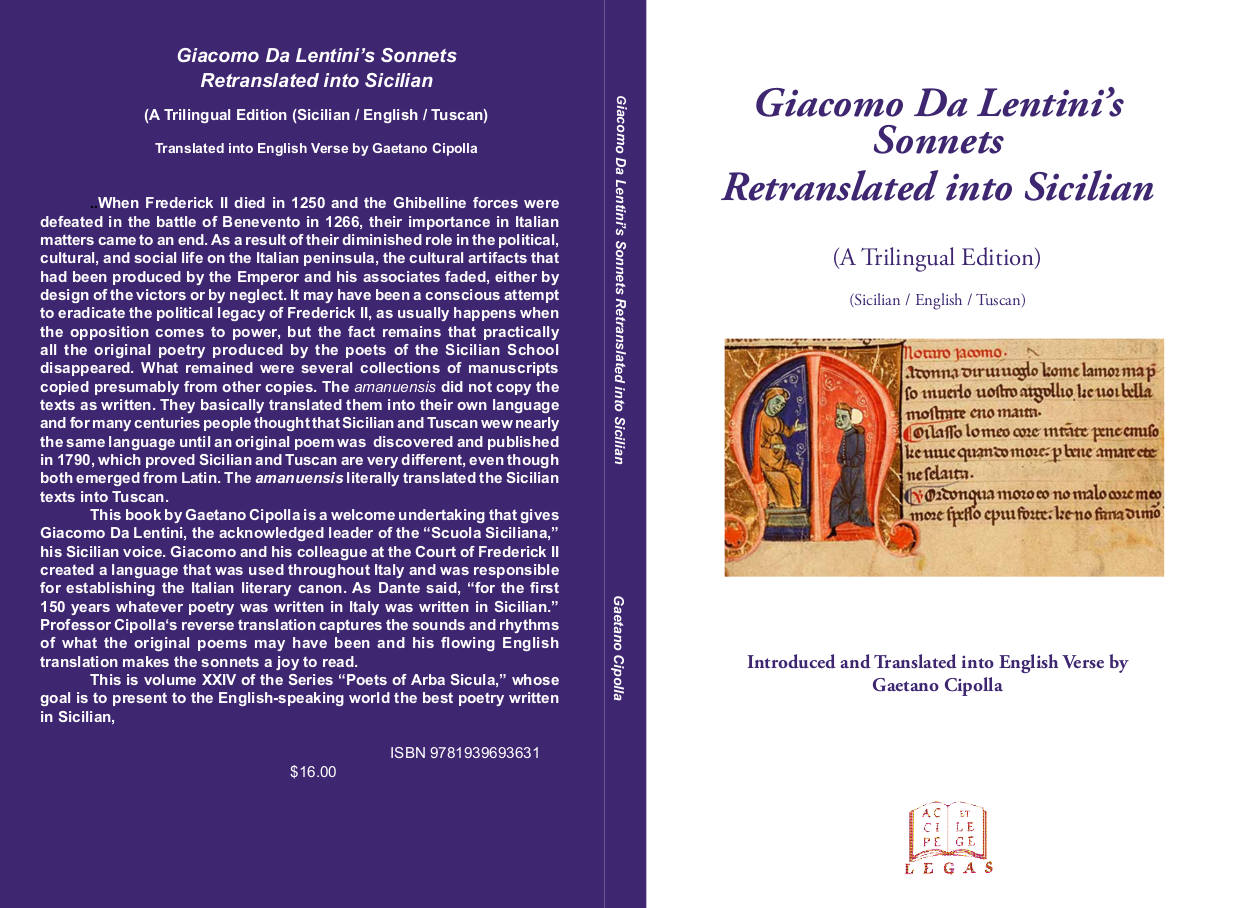
In the opening, after the summary, the reproduction of a page from a manuscript depicting the incipit of the famous song “Madonna dir vi voglio”, published by Legas in New York, this volume consists of eighty pages, in Sicilian, in English and in …’ Tuscan’.
“Who was Jacopu (or Giacomo) da Lentini?” we ask.
Frankly, we do not know much about his life, except what can be deduced from his writings.
We know that he was born in about 1210 in Lentini (SR), because he himself mentioned this in his song “Miravigghiusamenti”; we know that he was a notary in the service of Emperor Frederick II, because deeds, letters and other documents that he prepared bear a notation that they were written by “Jacobus de Lentini domini imperatoris notarius” or some other form identifying the person who prepared those documents (and this, on the other hand, clarifies and supports the custom, which continues to this day, of calling him a ‘Notary’); we do not know, with certainty, the date and circumstances of death, but presumably before 1250, the year of the Emperor’s death.
Jacopo da Lentini and the poets of the Sicilian School — a group of about 25 people at the beginning of the 13th century at the imperial Curia of Frederick II — introduced Provencal poetry into Italy. Written in Occitan, it blossomed in northern Europe thanks to the troubadours who traveled from one court to another, and usually accompanied by music and singing. It had become very popular. The poets of the Sicilian School brought this poetry into Italy, and translated it into the language spoken at the court of Frederick II, they refined it into a mature medium, and they made fundamental changes to it: they reduced the performative aspect of the troubadours, eliminating the music and the song that ran through the texts, and they concentrated their attention on the poetry, and in particular on one single theme of it, that of love, almost completely modifying everything else.
The theme of love, thanks to the “Scuola Siciliana,” continued to be the principal theme for the poets of the “Dolce Stil Novo”, and afterwards for Petrarch and Boccaccio as well as for the poets of the Renaissance. For the poets of the Sicilian School, love meant service and obedience to every wish of their chosen lady, hoping that eventually the woman would reward them with the joys of love; but the concept of love and the role of women gradually changed from generation to generation.
Notably credited as the inventor of the metric form of the sonnet, Jacopu da Lentini was probably the most important poet on the tree of Italian poetry, and to him are attributed 22 sonnets with certainty, and an additional 16 songs of various metric schemes.
Given that premise, why this work? what sense does it make? Gaetano Cipolla satisfies this question of ours without equivocating. However, before diving into his thoughts, we must devote a bio-bibliographic note to him.
Over the last 40 years, the American cultural organization Arba Sicula, of which Gaetano Cipolla is the soul, has devoted all its energy to the promotion of Sicilian language and culture in the world. Once a professor of Italian language and literature at various American universities and ultimately at St. John’s University in New York, he was born in Sicily in 1937 and emigrated to the United States in 1955, president of the American association “Casa Sicilia”, president and editor of Arba Sicula, a bilingual journal that features articles in English and Sicilian, and of the periodical Sicilia Parra, the cultural ambassador of the region of Sicily in the world, winner of prestigious prizes among which the “Telamone”, the “Trinacria d’argento” and the “Proserpina”, Gaetano Cipolla has the merit of having translated into English and published in the USA and in the world the works of several Sicilian poets and among them: Nino Martoglio, Giovanni Meli, Antonio Veneziano, Nino Provenzano, Vincenzo Ancona, Senzio Mazza, Nino De Vita, Piero Carbone, Salvatore Di Marco, Maria Nivea Zagarella and Marco Scalabrino.
The Sicilian School represented the beginning of Italian literature, of a literature written in an Italic language that differs from Latin. Coming from various regions of Italy, at the service in the court of Frederick II, the poets of the “Sicilian School” all wrote in Sicilian. The language that they used became the standard for poetry throughout Italy and established its literary canon; so much so that Dante Alighieri, in his De Vulgari Eloquentia, recognized its importance and said that all the poetry written in Italy was in Sicilian.
“Unfortunately,” Cipolla laments, thus coming to the heart of the question, “the vast production of the Sicilian School did not survive in the original form. After the death of Frederick II, in 1250, all the original poetry produced by the poets of the Sicilian School disappeared. What remained were several collections of manuscripts copied presumably from other copies.” The most important of them are: the Vaticano Latino 3793, the richest manuscript of the ancient Italian lyrical poetry in the Biblioteca Apostolica Vaticana, the Laurenziano rediano 9, in the Biblioteca Medicea Laurenziana of Florence, and the Palatino 418 now called Banco Rari 217 held in Florence, at the Biblioteca Nazionale Centrale.
It was the practice of the amanuensi to copy texts written in another language, adapting them to their own, so as to make them more accessible and comprehensible to their readers. The poetry of the Sicilian School survived only in the altered form made by amanuensis of different cities, primarily Florence, Pisa, Venice, and others, whose contributions were visible in the linguistic choices they made. Because the amanuensi did not limit themselves to changing the desinence of words, or to substituting one word with another: they produced texts that were more a translation than a mere copy, they applied the rules that characterized their language to the poems of the Sicilian School; so much so that in the end, lacking the original poems, the copies made by the amanuensis, were not much different from poems written originally in Tuscan, Pisan or Venetian.
Of course, the task of trying to divine the original text of the Sicilian poem poses often insoluble problems. Even though the substitution of rhyming Sicilian words may at first sight appear to be an easy task, the amanuensi faced many difficulties in adapting Sicilian into their “Tuscan” version.
“This observation,” Gaetano Cipolla notes, “is fully extensible to me. It goes without saying that today’s Sicilian has evolved and is quite different from what it could have been in the thirteenth century; nevertheless, I think that by substituting Sicilian endings, trying to limit the use of the apocope, and making only those changes that would not clash with the rules of the Sicilian language, I think I have scored a few points for my work. In my attempt to reconstruct the original language of the ‘Scuola’ — for which I examined both the texts of the amanuensi preserved in different cities as well as the translations of the originals available today — I had to face, like the amanuensi, many factors of difficulty, and not a few doubts arose about the choices to be made. But the efforts to try to recover what the original poems were, is worthwhile, if only to recapture the sounds, the musicality, and the rhythm of the originals. The result of such an operation may not reproduce the texts as they were ab origine, but they certainly would not sound like Tuscan or Venetian or Pisan. They would sound like the language that most Sicilians recognize as theirs. And that would be a welcome change that would shine a light on the poets of the Sicilian School, and give them credit for having created the literary canon of Italy.
“The enormous amount of scholarship that has been devoted to reconstructing those texts, filling the lacunae present in the manuscripts, trying to reach a consensus on what the poems say, have given the texts considerable prestige, even though different editions offer texts that are not exactly the same and often differ in substantial ways. Despite the alteration of the original Sicilian text done by the amanuensis, however, and by the different reconstructions done by the various editors, the kernel meaning of the poems comes through and can be used to reproduce a text that expresses the thoughts of the original creators.
“My Sicilian translation of the text that came to us (indeed this latter is a translation, not the original, with all the merits and demerits of the work of the amanuense who curated its adaptation) will therefore be,” continues Cipolla “valid in itself, as valid as the Tuscan or Venetian translations and will be judged on its merits.
“The translators of the time had the advantage of reading the original. Even so, a translation is never an exact copy, for words even within the same language are never exactly the same. The translator basically rides a seesaw trying not to overshoot the meaning of a word or expression and to maintain a proper equilibrium.
“Good translators,” reckons Cipolla, “manage to convey the kernel meaning of a poem and the amanuensis succeeded in most cases to convey that. And that is what I tried to do as well. While not the same as the original, the Sicilian versions are a reverse translation of sorts, that tries to work its way to what the original text may have been. It was a daunting task; but, after the first satisfactory attempt to retranslate one of the songs of giacopo da lentini, for the precision “Miravigghiusa-menti”, I felt encouraged to try the operation on a larger scale. My version, which I include in this volume, may not be exactly what Giacomo wrote but I submit that my seesaw did not ride too high or too low off the median swing.”
As Dante himself recognized on a page of his De Vulgari Eloquentia: “The language that [the members of the curia – officials, diplomats, notaries, poets and scientists – as well as the emperor himself] was illustrious, regal, aulic.” The language of Jacopo, therefore, was very complex, and consequently the Sicilian translation of his poems by Gaetano Cipolla presented considerable difficulties, especially considering that there are numerous words of foreign origin which have not entered the language of the people, which have not stood the test of time and are not included in Sicilian vocabularies.
“I do not pretend”, concludes Cipolla, “to have miraculously restored the poems of Jacopo da Lentini to their original form, for, as I’ve said, a translation can never hope reproduce a text written in another language in exactly the same form; and besides, at first, the idea of translating all of Jacopo’s poetry had never even occurred to me! At first it was an exercise to test my belief that the vast production of the poets of the Sicilian School could be restored, in part, to what they may have been before neglect or politics relegated them to silence or to speak with another voice. I felt it was a shame that the poets of the “Sicilian School”, who are credited with being the first to use their language in poetry, thus paving the way for the birth of Italian literature, have subsequently enjoyed so little consideration. I hope that the reader of my reverse translations, of my Sicilian versions contained in this book (2 songs and 30 sonnets, 2 of which are of dubious attribution, not much if one takes into account that the work of Jacopo, the recognized leader of the group, overshadows that of all the others) may inspire others to read and to appreciate his work more deeply; for my part, I’m happy to have given Jacopo da Lentini a Sicilian voice.”
In appendix, one can find in Tuscan “Meravigliosa-mente”, “Ben m’è venuto cordoglienza” and other sonnets. We’re about to close this short note with one emblematic example, one of the most celebrated sonnets of Jacopo da Lentini, a homage to the woman who shows originality, metaphor and religion.
Eu m’aju misu in cori a Diu sirviri
Eu m’aju misu in cori a Diu sirviri,
com’eu putissi jiri in paradisu,
ô santu locu, c’aju intisu diri,
unni s’havi sollazzu, jocu e risu.
Sanz’a me donna non vi vurrìa jiri,
chidda c’à testa biunna e claru visu,
ca sanza idda non putirìa gaudiri,
ristannu di la mia donna divisu.
Ma no lu dicu a tali intennimentu,
pirch’eu piccatu ci vulissi fari;
si non vidiri lu so purtamentu,
lu beddu visu e morbidu guardari:
chi mi tirrìa in gran cunzulamentu,
vidiri la mia donna in gloria stari.
I Have Decided to Serve God, Our Lord
I have decided to serve God, our Lord,
so I may earn a place in Paradise,
that holy realm that I have often heard
merriment, laughter and great joy supplies.
Without my lady, though, I would not go,
the one who has blond hair and a bright face,
because without her I just would not know
what joy is, were she in another place.
But I do not say this because I mean
to act with her in sinful or immoral ways,
I simply want to see her noble mien,
her lovely face, and her soft, loving gaze:
for it would be for me so very keen,
to see my lady basking in such praise.
Io m’aggio posto in core a Dio servire
Io m’aggio posto in core a Dio servire,
com’io potesse gire in paradiso,
al santo loco, c’aggio audito dire
o’ si mantien sollazzo, gioco e riso.
Sanza mia donna non vi voria gire,
quella ch’à blonda testa e claro viso,
che sanza lei nom poteria gaudere,
estando da la mia donna diviso.
Ma no lo dico a tale intendimento
perch’ io pecato ci vellesse fare;
se non veder lo suo bel portamento,
e lo bel viso e ‘l morbido sguardare;
che ‘l mi teria in gran consolamento,
veggendo la mia donna in ghiora stare.