
Giacomo da Lentini
Returning a Sicilian voice to Giacomo da Lentini: Gaetano Cipolla publishes a retranslation of the sonnets by the “notary”
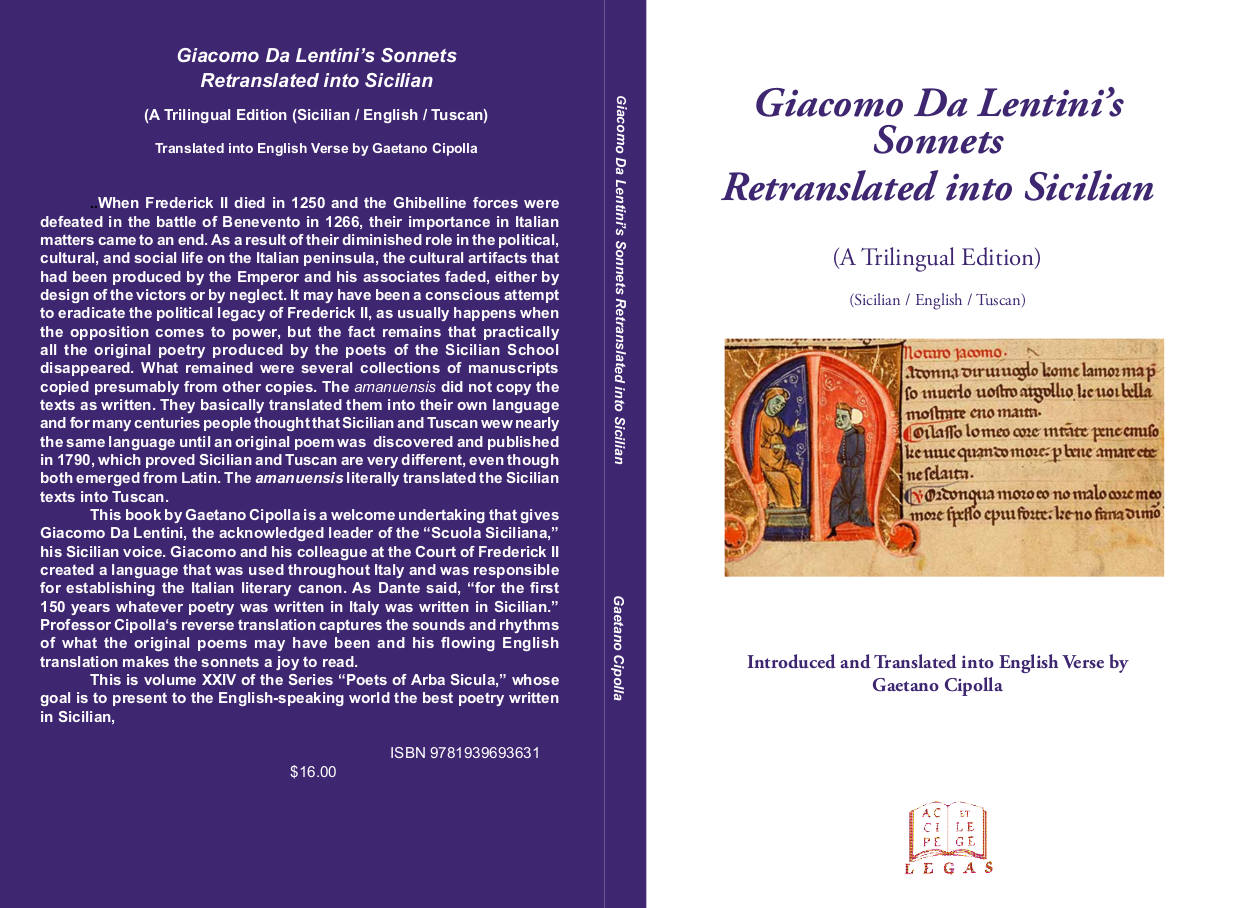
With Giacomo da Lentini’s Sonnets Retranslated into Sicilian, edited by Legas Publishing, the professor and scholar Gaetano Cipolla proposes a courageous cultural operation: to restore a Sicilian linguistic form to the verses of the Sicilian School.
by Accademia della lingua siciliana
adapted from a review by Marco Scalabrino
Eight centuries after the birth of the Sicilian School, Giacomo (or Jacopo) da Lentini returns ideally to speak the language of his land, his maternal language: Sicilian. This is the objective of the new volume Giacomo da Lentini’s Sonnets Retranslated into Sicilian, edited and translated by Gaetano Cipolla and published by Legas Publishing of New York a few months ago. “The fact that the poets of the Sicilian School speak Tuscan is something unacceptable from my point of view,” says Cipolla. “My intention was to return to Giacomo da Lentini’s native language to him.”
The eighty-page book opens with a reproduction of a manuscript page containing the incipit of the famous song “Madonna, dir vi voglio,” offering from the first pages a suggestive immersion into the origins of poetry in Italy. The texts are presented in three versions: Sicilian, English and “Tuscan”, allowing the reader to directly compare the different linguistic traditions.
A central figure at the court of Frederick II, Giacomo da Lentini is universally recognized as the inventor of the sonnet and the chief exponent of the Sicilian School, the poetic movement that in the thirteenth century laid the foundations for vernacular literature in Italy. The imperial notary, author of twenty-two sonnets of certain attribution and author of sixteen songs (together with the other poets of the Frederican court) introduced the systematic use of vernacular in Italy for high-quality literary production. The Sicilian School consecrated the theme of love as the fulcrum of Italian poetry, exercising an influence destined to reach the Dolce Stil Novo, Retrarch, and the whole Renaissance tradition.
Cipolla’s volume faces one of the most fascinating problems in medieval philology: the “loss” of the Sicilian originals. After the defeat of the Swabian dynasty at the Battle of Benevento in 1266, he went up and the Angevin conquest of the Kingdom of Sicily, the works of the Sicilian School were almost entirely destroyed. What we know today is derived from copies made by amanuensi, above all Tuscan ones, who systematically adapted the language of the texts to their own dialect. More than simple transcriptions, those copies were real linguistic translations that deeply changed the original face of the Sicilian poetry, so much that some rhymes no longer matched.
Gaetano Cipolla’s work is based precisely upon this awareness. Through a careful comparison of the principal medieval manuscripts, the scholar attempted a “reverse translation”, bringing the texts into a modern Sicilian, which, while not claiming to coincide perfectly with that of the thirteenth century, restors to the verses the sound, rhythm, and musicality attributable to their original form.
“The objective,” explained Cipolla, “is not to miraculously reconstruct the lost originals, but to offer a version that does not sound Tuscan but rather Sicilian, giving the poets of the School the credit for creating the first canon of Italian literature.”
In the volume there are two songs and thirty sonnets — two of which are doubtful attribution — accompanied by English translations. The appendix also includes the texts from the Tuscan tradition, allowing the reader to immediately grasp the linguistic and stylistic differences.
Among the most significant compositions is the famous sonnet “Io m’aggio posto in core a Dio servire”, proposed in the new Sicilian version as “Eu m’aju misu in cori a Diu sirviri”, alongside the English translation and the text of the Tuscan manuscripts. An emblematic example of the editorial approach of the volume, which aims to offer both a study tool and a literary rediscovery.
For over forty years, Gaetano Cipolla has been one of the most authoritative figures in the international promotion of the Sicilian language and culture. Born in Francavilla di Sicilia in 1937 and emigrated to the United States in 1955, he was a professor of Italian language and literature at St. John’s University in New York, and is currently a member of the Scientific College of the Accademia della Lingua Siciliana, in addition to president of Arba Sicula and editor of the journals Arba Sicula and Sicilia Parra. In the course of his activity, he has translated many Sicilian authors into English, from Giovanni Meli to Nino Martoglio, from Giuseppe Fava to Antonino Provenzano, contributing in a decisive way to the spread of Sicilian literature around the world.
With this new publication, Cipolla adds an important piece to the debate on the reconstruction of the language of the Sicilian School, reaffirming the historical role of Sicilian as the primary language of systematic poetic production in Italy and inviting scholars and readers to rediscover Giacomo da Lentini not only as the inventor of the sonnet, but as a poet who, thanks to this “rediscovered voice,” can still speak with surprising relevance.
translated from the original published on 22 July 2026 in:
- L’Epoca Culturale
- Blog Sicilia
- Sicilia Oggi Notizie
- Palermomania
- Canicattì Web
- Tam Tam TV
- Enna Press
- Easy News Press Agency
below is a link to the longer review by Marco Scalabrino (28 June 2026):